
Manchester Airport Connections in 2026: T2, T3, Skylink and the Ticket That Decides Your Risk
Some links on this website may earn us a commission at no extra cost to you. Read our Affiliate Disclosure.
Introduction
You’ve cleared the UK Border at Terminal 2, your hold luggage is on the carousel, and your onward flight leaves from Terminal 3. That’s a landside connection, and the Skylink walk is only part of it.
KEY TAKEAWAYS
- Manchester now runs two terminals: Terminal 2 for every airline except Ryanair, and Terminal 3 for Ryanair only. Terminal 1 is closed.
- Your ticket type decides your risk: a through-ticket generally protects a valid connection disrupted by an earlier flight; separate tickets usually leave you paying unless extra cover applies.
- Confirm your terminal with the official Which Terminal? tool and your airline before you travel. Allocations changed in late 2025.
Standing at the Terminal 2 arrivals board with a Ryanair boarding pass in my hand, I stopped trusting old terminal maps and started checking the official Which Terminal? tool before every Manchester connection.
If you’re self-connecting, a missed connection usually means buying a new ticket at your own cost unless separate cover applies. A through-ticket generally protects you against a missed connection caused by an earlier flight’s disruption. Your ticket type decides your risk.
This guide gives you the exact steps and realistic buffers for each scenario. You’ll know before you land whether you must clear the UK Border, collect and re-check hold luggage, re-clear security, walk the Skylink, and whether your layover is actually long enough.
Read the section that matches your ticket type, and confirm your terminal with the official Which Terminal? tool before you travel. Before the steps, you need the lay of the land. Here is what actually changed.
Manchester Airport’s 2026 Terminal Layout: What Actually Changed
The old maps are wrong. Dangerously wrong, because Manchester Airport finished a terminal reshuffle that changed where almost every airline lives. If you saved a terminal guide before November 2025, or a relative is quoting what worked for them two years ago, that advice no longer describes this airport. What survived the change is now the only advice worth carrying.
The Two-Terminal Reality After Terminal 1 Closed
Manchester now operates exactly two terminals. The Terminal 1 name is gone, retired in stages rather than in a single dramatic closure.
The final airlines moving to Terminal 2 had completed their moves by 19 November 2025, when easyJet completed its shift into Terminal 2 in the same week Emirates began parking A380s on the new second pier.
The Terminal 1 name itself was retired on 5 March 2026, and by that month the airport’s media centre had declared Manchester a two-terminal airport for the first time in more than 30 years.
The practical translation matters more than the dates. Terminal 2 absorbed the overwhelming majority of traffic after a £1.3bn expansion, and it now handles around 75% of Manchester’s passengers. Both Flight Transfer Centres sit in Terminal 2. Terminal 3, meanwhile, has expanded into the former Terminal 1 space, with a new entrance, a new security hall and more than 250 extra seats already open.
The brand promise of a “two-terminal airport” sounds tidy until you watch someone live it. A colleague landed at Terminal 2 in late 2025, saw “Terminal 3” on his onward boarding pass, and assumed a short airside hop existed. He spent twenty minutes looking for a transfer desk that Manchester does not operate for that combination. The design choice that looks clean on a press release plays out as a landside transfer, border checks where applicable, and a bag re-check for anyone with hold luggage touching Ryanair. That is the unglamorous truth: the airport’s simplified layout simplified the airport, not the passenger’s day.
Why the Airline Reshuffle Matters for Connections
A connection you made a year ago may now use completely different terminals. This is the direct consequence of completing the move of every airline except Ryanair into Terminal 2 by November 2025, and it catches real passengers every week. Terminal advice written before the final moves may describe an airport layout that no longer applies.
Jet2 deserves a special warning for connectors. It is one of Manchester’s biggest airlines, and it operates as a point-to-point airline and does not sell flights with onward connections. There is no Jet2 transfer product to ask for. Any itinerary that includes a Jet2 leg is a self-connect, even Jet2-to-Jet2, which catches people who assume a single airline means a protected connection.
Current Airline Allocations at a Glance
The confirmed allocation fits in two lines. Terminal 2 is home to easyJet, Jet2, TUI, Emirates and the large majority of all carriers. Ryanair alone occupies Terminal 3, with check-in using the former Terminal 1 check-in hall.
Manchester Terminal Changes: November 2025 to March 2026
Manchester retired Terminal 1 in stages between November 2025 and March 2026. The order the changes landed shows which terminal advice still holds at check-in.
| When | What | Why |
|---|---|---|
| Before November 2025 | Older terminal guides may list three terminals and outdated airline allocations | Advice saved before this date describes an airport layout that has since closed |
| Late 2025 | Carriers complete their moves into the expanded Terminal 2, the £1.3bn facility | A connection you made a year earlier may now route through a different terminal |
| 19 November 2025 | easyJet and Emirates complete their moves into Terminal 2; Ryanair continues using the T1/T3 footprint | Terminal 2 becomes the home of every carrier except Ryanair |
| Week of 19 November 2025 | Emirates starts parking A380s on Terminal 2‘s new second pier | Emirates A380 flights can now use Terminal 2’s second pier |
| 5 March 2026 | Manchester retires the Terminal 1 name | Three-terminal signage and wayfinding stop applying to any journey |
| By March 2026 | Terminal 3‘s expansion into the former Terminal 1 space opens with a new entrance, a new security hall and more than 250 extra seats | Ryanair passengers check in at the former Terminal 1 check-in hall |
| March 2026 | The airport’s media centre declares Manchester a two-terminal airport for the first time in more than 30 years, with Terminal 2 handling around 75% of passengers | The two-terminal layout becomes the official position behind every allocation |
| Current published guidance | Both Flight Transfer Centres operate inside Terminal 2 | Eligible connections can stay airside; confirm airline participation and any border or security checks for your route |
| March 2026 onward | Ryanair operates alone from Terminal 3 | Ryanair offers no transfer service: complete arrivals, collect any hold luggage, then depart again; use the Skylink only for a terminal change |
Terminal allocations are drawn from Manchester Airport’s official announcements through March 2026. Confirm your own flight with the airport’s Which Terminal? tool before you travel.
That leaves two broad connection routes at Manchester: an eligible Terminal 2 airside transfer, or a landside self-connect. A self-connect can stay within either terminal or require the Skylink between them. Confirm your own flight with the official Which Terminal? tool before you rely on any of this.
How to Confirm Your Terminal Before You Travel
The layout is settled, but your own flight’s terminal is not something to guess. Three checks before you travel will settle it.
Why does your booking still say Terminal 1? I have watched this exact confusion repeat across several trips since the reshuffle. The number that made it click for me: around 75% of Manchester Airport’s passengers now use Terminal 2, which means the odds heavily favour T2 unless you are flying Ryanair. Once I started checking the official tool against that baseline, the mismatches stopped surprising me.
Use the Official Which Terminal? Tool
Start with the official Which Terminal? finder. Search by airline and it shows the current terminal, reflecting the late-2025 move that left Ryanair as the only Terminal 3 airline.
EXPERT TIP
Check your terminal with the official Which Terminal? tool before travelling, because airline allocations changed in late 2025 and old booking confirmations or third-party sites may still show Terminal 1.
Confirm With Your Airline Directly
The airline’s app or booking confirmation typically shows arrival and departure terminals. Check it even after using the airport’s tool, especially for separate-ticket connections. Separate-ticket connections do not carry standard through-ticket protection; check any extra protection you bought, and use your airline’s current terminal listing.
Download Your Boarding Passes and Terminal Map Before Landing
Download your boarding passes in the format your airline accepts and save a terminal map before landing. Airport Wi-Fi can be slow. The live arrivals and departures pages show gate information and last-minute changes.
Once you know your terminals, here is exactly what happens in each transfer scenario.
Step-by-Step Connection Scenarios: Exactly What to Expect
Which steps you repeat, and whether you can stay airside, depends on the terminals involved, your ticket type and your arrival and onward routes. Here is each scenario in order.
Scenario 1: Connecting Within Terminal 2 (Airside Transfer)
This is the only scenario where you stay airside. It requires both flights in Terminal 2 on a through-ticket with a participating airline, since not every airline uses Manchester’s transfer service. For an eligible international-to-international transfer, follow signs for Flight Connections, present your onward boarding pass, and proceed to the departure area without clearing the UK Border or collecting hold luggage. Confirm that your bags are tagged to the final destination. International-to-UK domestic connections require UK entry checks; follow staff instructions for any transfer security screening.
Scenario 2: Transferring From Terminal 2 to Terminal 3 (Landside Transfer)
There is no airside link between Terminal 2 and Terminal 3, so you complete the full arrivals process first. Disembark, follow signs for Arrivals and Baggage Reclaim, clear the UK Border where required, and collect any hold luggage. Then follow signs for the Skylink walkway to Terminal 3, re-check your hold luggage, clear security, and proceed to the gate.
EXPERT TIP
If transferring between Terminal 2 and Terminal 3, expect to clear the UK Border where required, collect and re-check any hold luggage, and allow 5 to 15 minutes for the Skylink walk itself, longer with bags, lifts and crowds.
Five minutes of moving walkway carried me from Terminal 2 to Terminal 3 on my last connection, and that short walk is why the border queue, not the Skylink, decides whether you make it.
Scenario 3: Transferring From Terminal 3 to Terminal 2 (Landside Transfer)
The Terminal 3 to Terminal 2 transfer is the same landside process in reverse. No airside shortcut exists in either direction. Disembark, clear the UK Border where required, collect any hold luggage, walk the Skylink to Terminal 2, re-check bags, clear security, and proceed to the gate.
Scenario 4: Self-Connecting Passengers (Any Terminal Combination)
Self-connecting passengers follow the full landside process regardless of terminal combination, because the airline does not provide a through-transfer for separate bookings. Clear the UK Border where required, collect any hold luggage, check in if not already done, re-check bags, and re-clear security. A missed connection is usually the passenger’s cost unless separate cover applies.
Each scenario has a different time cost. Here are the numbers to plan against.
Minimum Connection Times and Recommended Buffers
The steps are fixed; the time they take is where most people get it wrong. Minimum connection times depend on the airlines, route and transfer involved. Ask your airline to confirm the applicable minimum for your actual itinerary; a filed minimum carries no promise that a self-connect will work.
There is no airside transfer between Terminal 2 and Terminal 3. Every T2↔T3 move is landside: clear the UK Border where required, collect any hold luggage, walk the Skylink, re-check bags, re-clear security. An airline-approved through-ticket connection and a self-connect passenger on separate tickets do not carry the same protection. The 4+ hour self-connect buffer below is a planning allowance, not an airport minimum or a guarantee; allow longer for delays, hold luggage, assistance or an onward flight you cannot afford to miss.
The departure board still showed “boarding” when I cleared the last security scanner, but my watch read 137 minutes since landing. The two-hour gap had looked like margin on paper. The UK Border queue ate 25 of those minutes before I’d even seen a carousel, and my hold luggage took another 18 to surface. Then came the Skylink walk to Terminal 3, the Ryanair bag-drop queue, and security’s 100ml rule slowing every tray. I’ve done this transfer enough times over the years to know the pattern: a tight connection assumes everything runs clean. It rarely does.
Eligible through-ticket connections within Terminal 2 can use the Flight Transfer Centres and stay airside. Ryanair in Terminal 3 offers no transfer service at all.
| Transfer scenario | Minimum connection time | Recommended buffer | Key notes |
|---|---|---|---|
| Terminal 2 airside transfer (through-ticket) | Airline- and itinerary-specific; confirm when booking | Meet the airline’s minimum; allow extra time where possible | Eligible Flight Transfer Centre users stay airside; confirm bag tags and required checks |
| Terminal 2 to Terminal 3 landside transfer | No protected self-connect minimum | 4+ hours as a planning allowance; longer where needed | No airside transfer; UK Border where required, baggage reclaim and Skylink walk |
| Terminal 3 to Terminal 2 landside transfer | No protected self-connect minimum | 4+ hours as a planning allowance; longer where needed | Same landside process in reverse; Ryanair offers no transfer service |
| Self-connect (any terminal combination) | No protected minimum | 4+ hours as a planning allowance; not a guarantee | Onward-flight risk usually rests with you; check any extra cover and allow check-in, bag drop and security time |
Time is only half the picture; whether your bags follow you is the other half.
Baggage Rules: Through-Ticket Versus Self-Connect
Buffers assume your bags move with you. Whether they do depends on your ticket and the airline’s transfer arrangements.
When Your Bags Are Checked Through
On a through-ticket, one ticket covering the whole journey, hold luggage is typically checked through to your final destination. Confirm the destination on your bag tag. For an eligible international-to-international Terminal 2 airside transfer, you do not collect bags at Manchester or pass through UK passport control, so no UK ETA is needed. A Direct Airside Transit visa may still be required for some nationalities.
When You Must Collect and Re-Check Your Bags
There is no airside baggage transfer between Terminal 2 and Terminal 3. Under the current airline allocations, a T2↔T3 connection involving Ryanair means collecting and re-checking hold luggage. The same applies to all self-connecting passengers.
The sequence: collect at baggage reclaim, clear customs, walk the Skylink route, re-check at the onward airline’s desk, then proceed through security.
The Self-Connect Risk: What You Are Responsible For
Self-connecting passengers generally bear the cost of a missed onward flight: standard through-ticket rebooking and care do not apply to the whole journey. Rights relating to the disrupted individual flight still apply, and insurance or separate connection protection may help. This is the key difference from a through-ticket, and it directly affects how much buffer time you need.
EXPERT TIP
If you are self-connecting, use 4+ hours as a planning allowance, add more time for hold luggage or peak periods, and check travel insurance or connection-protection terms. No buffer guarantees an onward flight.
Keep Essentials in Hand Luggage
Keep medication, valuables and a change of clothes in your hand luggage in case hold bags are delayed on a connection.
EXPERT TIP
Book a through-ticket on one airline or alliance whenever possible. Confirm that bags are checked through and that your connection is protected against an earlier flight’s disruption, which removes most of the stress and risk from a Manchester connection.
Bags are one part of the landside process; the UK Border is the other.
UK Border and Security Requirements
The landside process has two hard gates: the UK Border and security. Which one you face depends on your ticket, terminal and arrival and onward routes.
Who Must Clear the UK Border
Eligible international-to-international Terminal 2 airside connections can skip the UK Border. Landside transfers from outside the Common Travel Area normally pass through it; arrivals from elsewhere in the UK or Ireland follow different arrival arrangements. Eligible chipped-passport holders can use eGates, subject to age, height and other requirements. Neither eGates nor staffed desks guarantee a short queue.
“Do I really need an ETA for a Terminal 3 connection?” a client asked, a question I field most weeks. The answer depends on nationality and immigration status: T3 connections are landside, but British and Irish citizens and people with qualifying UK permission do not need an ETA. For travellers who do need one, it currently costs GBP 20.
ETA-eligible travellers who are not exempt need a UK Electronic Travel Authorisation for landside transit. Others may need a visa instead. Check GOV.UK for your nationality and route before booking; an ETA does not guarantee admission.
Security Screening: When You Need to Re-Clear
Any landside step, whether a terminal change, bag collection or re-check, forces a security re-screen. Manchester still limits non-exempt liquids in hand luggage to containers of 100ml or less, so a larger bottle accepted at your departure airport may not be allowed through here. Medical, baby-food and qualifying sealed duty-free exemptions have separate conditions. Pack to Manchester’s rule for the whole trip if your routing re-screens there.
Terminal 2 Flight Transfer Centres: Staying Airside
Terminal 2 has two dedicated Flight Transfer Centres that let eligible through-ticket passengers connect airside without leaving the secure area. If your international-to-international connection stays within Terminal 2 on an eligible single ticket with bags checked through, you can avoid UK entry control. Staying airside does not guarantee that you skip transfer security; follow staff instructions. The hard limit is that there is no airside route of any kind to Terminal 3.
EXPERT TIP
If your connection stays within Terminal 2 on a through-ticket, check with your airline whether you are eligible for a Flight Transfer Centre. Eligible international-to-international airside transfers can avoid UK entry control; follow staff instructions for transfer security.
The walk between the terminals is the physical part of that landside process.
Getting Between Terminals: The Skylink Walkway
The Skylink is the signed pedestrian link between the two terminals. Here is the walk itself.
Route, Distance and Walking Times
The Skylink runs via The Station, the airport’s railway station complex. It is covered, step-free and free to use, providing shelter along the route.
Walking times vary with pace and luggage. AccessAble lists the Terminal 2 to The Station route as about 407 metres. Manchester Airport quotes 5 to 15 minutes between Terminal 2 and Terminal 3, with moving walkways along parts of the route. Allow 15 to 20 minutes as a planning buffer, and longer for bags, lifts, crowds or assistance.
I made the mistake of assuming the Skylink was a straight five-minute corridor. On a rushed connection last spring, the search for a direct route led me past the same signage twice, and I missed that the walk swings through The Station. That detour cost me ten confused minutes of backtracking with a wheeled case. What fixed it was accepting the route for what it is: The Station to Terminal 2 is about 407 metres, and I allow 15 to 20 minutes for the full walk. Now I build that into my mental map before I land.
EXPERT TIP
Use the covered Skylink walkway rather than a taxi between Terminal 2 and Terminal 3: it is free and covered; allow extra time for lifts, crowds or assistance.
What to Expect Along the Way
The route passes through The Station interchange, the midpoint where most people pause to check signage. Travelators help along parts of the route, and lifts and help points are available throughout. The walk is straightforward. With hold luggage or tired children, though, it can feel long.
Accessibility and Assisted Travel on the Skylink
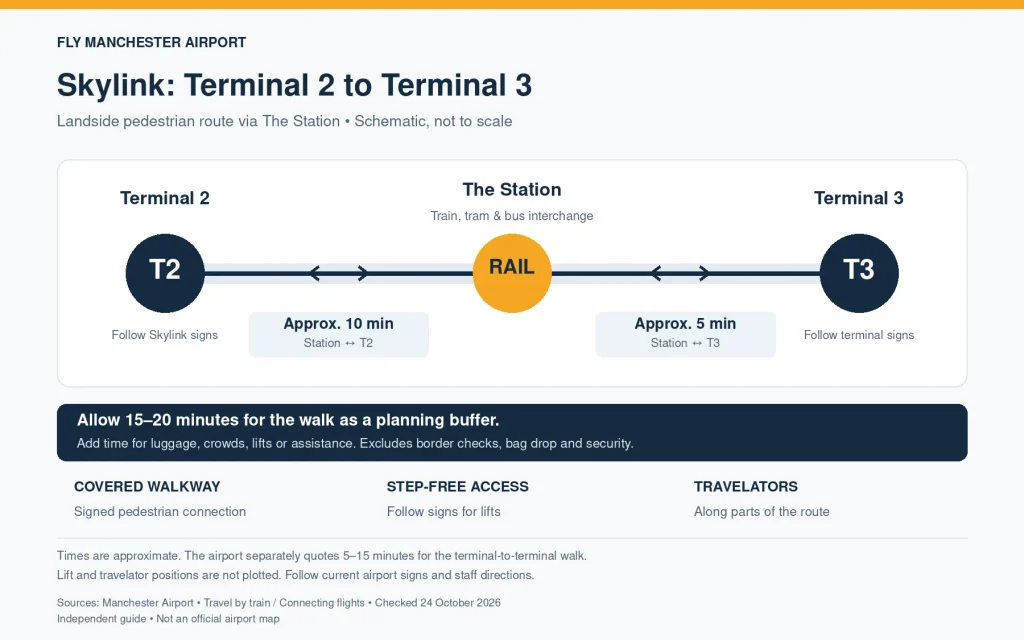
The Skylink is step-free with lifts, so passengers with reduced mobility or travelling with children can manage the route. For extra support, request assisted travel through your airline or travel agent at least 48 hours before departure, including help with your connection. There is plenty of help for passengers needing accessibility services transferring between terminals.
Even with the right buffer, things go wrong. Here is what to do if you miss it.
What to Do If You Miss Your Connection
If the Skylink walk has already failed you and the connection is gone, the first hour decides how much it costs you.
The baggage carousel’s belt made a low grinding sound as it lurched to a stop, and the departure board above it flickered. My onward flight’s gate had already flipped to “CLOSED” while my hold luggage was still circling. That’s the tell I’ve learned to read at Manchester: if you’re still landside when the gate closes, the connection is gone, and the only useful move is finding airline staff before that moment, not after.
Immediate Steps: Speak to Airline Staff
If your first flight is delayed and the connection looks at risk, speak to airline staff immediately. Ideally before landing, if the delay is known in advance. Cabin crew may be able to advise or alert ground staff; arrange rebooking through the airline’s app, contact centre or ground team.
EXPERT TIP
If your first flight is delayed, tell cabin crew or airline staff before you land. Ask about onward arrangements and use the airline’s app, contact centre or ground team for rebooking.
Through-Ticket Protection: What Your Airline Must Do
On a through-ticket, if an earlier flight’s disruption causes you to miss a valid connection, contact the airline for rerouting at no extra cost under the applicable rules and ticket conditions. Meals and overnight accommodation may also be due where passenger-rights rules apply. Standard through-ticket protection does not extend to independently booked onward flights.
Self-Connect Consequences and Travel Insurance
Self-connecting passengers have no standard airline protection for the onward connection. Miss it, and you normally buy the new ticket at your own expense. Travel insurance with missed-connection cover or a separately purchased connection-protection service may help, so check the terms before travelling.
Compensation and Assistance Basics
UK and EU compensation rules for flight delays depend on route, delay length and reason. For a protected connecting journey, arrival delay at the final destination can matter; separate tickets are assessed as separate journeys. This is general travel advice rather than something specific to Manchester Airport, so check official sources for current thresholds.
To avoid needing this section, use the decision-tree to find your exact path.
Interactive Connection Decision-Tree: Find Your Exact Steps
Three questions, answered in order, and you know exactly which steps your connection involves.
- Where do you arrive: Terminal 2 or Terminal 3?
- Where do you depart: Terminal 2 or Terminal 3?
- What ticket do you hold: through-ticket or self-connect?
The branches are simple.
- If Terminal 3 appears anywhere in your journey, you take the landside path. Use the Skylink only if you change terminals; T3-to-T3 connections stay in Terminal 3.
- If both flights are in Terminal 2 and you hold a through-ticket, you may qualify for the airside transfer route.
- If you are self-connecting, you always take the landside path and collect any hold luggage.
That last branch is where people come unstuck. A self-connecting colleague missed his Ryanair connection after relying on a two-hour gap, because the landside Skylink and bag re-check needed the full three hours. The tree exists to remove that guesswork before it costs you a flight.
Manchester Connection Selector: Terminal and Ticket
Manchester runs two terminals in 2026: Terminal 2 takes every airline except Ryanair and handles around 75% of passengers, Terminal 3 takes Ryanair. Answer the three questions in order.
Which terminal does your arriving flight land at?
- Terminal 2: Step-by-Step Connection Scenarios: Exactly What to Expect. Terminal 2 holds the Flight Transfer Centres and the airside route for eligible through-ticket passengers.
- Terminal 3: Step-by-Step Connection Scenarios: Exactly What to Expect. Ryanair is the only carrier at Terminal 3, and the Skylink walkway links it with Terminal 2 if you need to change terminals.
Which terminal does your onward flight leave from?
- Terminal 2: Step-by-Step Connection Scenarios: Exactly What to Expect. An arrival and a departure both in Terminal 2 keep the airside transfer on the table for through-ticket holders.
- Terminal 3: Getting Between Terminals: The Skylink Walkway. For a Terminal 2 arrival, allow 15 to 20 minutes as a walking buffer via The Station, after completing arrivals and any required UK Border checks. A T3-to-T3 self-connect stays in Terminal 3.
Which ticket do you hold for the two flights?
- Through-ticket: Baggage Rules: Through-Ticket Versus Self-Connect. Confirm that your bags are checked through and your airline accepts the connection. Eligible international-to-international airside transfers avoid UK entry control and do not require an ETA, though some nationalities may need an airside transit visa. Ask your airline for the minimum connection time for your itinerary.
- Self-connect: Baggage Rules: Through-Ticket Versus Self-Connect. You take the landside path and collect any hold luggage. Use 4+ hours as a planning allowance, not a guarantee, and check the onward airline’s check-in, bag-drop and boarding deadlines.
Terminal 3 anywhere in the journey means the landside path; use the Skylink only when changing terminals. AccessAble lists The Station to Terminal 2 segment at about 407 metres.
Print or screenshot the checklist below so the plan survives the day itself.
Printable Pre-Flight Connection Checklist
The decision-tree above gives you your path. This checklist makes sure the prep is done before you fly. Print the page or screenshot it before you travel.
A passenger at the T2 Flight Transfer Centre is staring at the Skylink sign, convinced the walk to T3 will be the thing that ruins the connection. The airport quotes 5 to 15 minutes for the walk, but bags, lifts, crowds and assistance can add time. What actually decides the outcome is the ticket. An eligible international-to-international through-ticket connection can keep you airside and avoid UK entry control, while a self-connect requires the landside process. The passengers who fret about the walk and ignore the ticket type are the ones who miss flights.
- Confirm terminal. My arrival terminal is ______ and my departure terminal is ______. T2 handles most passengers; T3 is Ryanair only.
- Decide baggage plan. I hold a ______ (through-ticket / self-connect), and my airline has confirmed my hold luggage is ______ (checked through / collected and re-checked).
- Know UK Border requirement. I will ______ (clear / skip) the UK Border because ______.
- Prepare for security. My liquids are in containers of 100ml or less and my liquids and electronics can stay in my hand luggage unless security staff ask otherwise.
- Set buffer. My planned connection time is ______ minutes. My airline has confirmed the minimum for my through-ticket itinerary. For a self-connect, I have allowed 4+ hours as a planning buffer, checked onward deadlines, and added more time where needed.
- Save emergency contacts. My airline’s number is ______ and my travel insurer’s number is ______.
Quick answers to the questions readers ask most follow.
Frequently Asked Questions About Manchester Airport Connections
The short answers, for when you are already at the gate.
Do I need to clear the UK Border when connecting through Manchester?
For a landside transfer arriving from outside the Common Travel Area, normally yes. Eligible international-to-international through-ticket connections within Terminal 2 can use the Flight Transfer Centres without passing UK entry control. UK domestic and Ireland arrivals follow different arrangements; a Terminal 3 connection alone does not determine whether you pass passport control.
Will my hold luggage be checked through to my final destination?
On a through-ticket, your hold luggage is usually checked through; confirm its final destination on the bag tag. On separate tickets, you collect it yourself and check it in again with your onward airline. If you are unsure which category you fall into, ask your airline: participation in Manchester’s transfer services varies by carrier.
How long does the walk between Terminal 2 and Terminal 3 take?
The Skylink walk typically takes 5 to 15 minutes, with moving walkways on parts of the route. The walk itself is the easy part. Getting landside in the first place is what costs you time.
What is the minimum connection time at Manchester Airport?
Ask your airline for the minimum connection time for your actual flights. It can vary by airline, route and transfer type. A filed minimum is not a realistic guarantee for a two-terminal self-connect; the 4+ hour allowance in this guide is planning guidance, not an official airport minimum.
Is there an airside link between Terminal 2 and Terminal 3?
No. There are no direct transfer facilities between the two terminals, so every cross-terminal connection means clearing the UK Border where required, collecting any hold luggage, and walking the Skylink landside.
What happened to Terminal 1?
Terminal 1 closed in March 2026. Ryanair remains in Terminal 3, and every other airline now operates from Terminal 2.
What should I do if I miss my connection?
See the missed-connection section for the exact steps and who to contact. The short version: your remedy depends heavily on whether you hold a through-ticket or booked separate tickets.
Here are the sources and the date this was last checked.
Sources and Last Updated
Everything above rests on these sources, checked in 2026:
- Manchester Airport: Connecting flights (checked 24 October 2026)
- Manchester Airport and AccessAble: Skylink route and rail access (checked 24 October 2026)
- Manchester Airport: Which terminal (checked 24 October 2026)
- GOV.UK: Border control, ETA, and transit visa (checked 24 October 2026)
Airline transfer policies were checked against Manchester Airport, Jet2 and easyJet guidance. OAG explains how minimum connection times vary; confirm the applicable minimum with your airline.
Terminal allocations and walking times change. The final airlines moved into Terminal 2 as recently as November 2025. Re-check before you travel, and always confirm your terminal and connection with your airline.