Manchester Airport Liquid Rules 2026: 100ml Still Applies
Some links on this website may earn us a commission at no extra cost to you. Read our Affiliate Disclosure.
Introduction
Standing at the Manchester security belt with my toiletry bag still zipped, I stopped unpacking liquids and left each 100ml bottle in my hand luggage, trading the plastic-bag ritual for a faster belt.
Headlines keep saying UK airports have scrapped the 100ml rule. Manchester hasn’t. Pack a 150ml sunscreen thinking the rule is gone and security will confiscate it, maybe after you’ve already queued. The 2-litre allowance is live at Heathrow, Gatwick, Birmingham and Edinburgh. Not Manchester.
KEY TAKEAWAYS
- Manchester still enforces 100ml per container in 2026; the 2-litre allowance has not been approved there.
- No clear plastic bag is needed, and liquids can stay in your hand luggage at Manchester’s CT scanners.
- Check the official Manchester Airport security page before you fly. Rules are under active review.
Here’s the Manchester-specific answer in one line: CT scanners mean no plastic bag and no unpacking, but every container must still be 100ml or less. That single distinction is what catches people out, because the relaxed rules at other airports get reported as if they apply everywhere.
What Manchester actually enforces right now is simpler than the headlines make it look.
Manchester Airport Liquid Rules in 2026: The Definitive Status
The headlines are real, but they don’t apply everywhere. Here’s what Manchester actually enforces.
The 100ml Rule Still Applies (as of 18 October 2026)
Manchester still enforces the 100ml per-container limit in 2026. The 2-litre allowance has not been approved for the airport, despite the introduction of CT scanners.
Why the Rules Changed at Some Airports But Not Manchester
CT scanners mean you can leave liquids in your hand luggage, and you no longer need a plastic bag. That change is separate from approval to carry containers of up to 2 litres. Manchester has the scanner-related change, but not the larger allowance.
The scanner makes the routine simpler, but it can give the wrong impression about the rule. If I were checking a colleague’s cabin bag before a Manchester flight, I’d let them leave their liquids inside, then pause when they reached for a larger toiletry bottle because there was no plastic bag to pack. I’d point out that the scanner changes how security screens the bag, not the container limit. That correction could spare them a confiscated item and a last-minute repack.
Myth-Busting: No, Manchester Has Not Scrapped the 100ml Rule
Three claims are false: ‘Manchester has scrapped the 100ml rule’; ‘all UK airports allow 2 litres’; and ‘CT scanners automatically raise the container limit’. Heathrow, Gatwick, Edinburgh and Birmingham allow up to 2 litres, which makes Manchester an outlier among major UK airports.
EXPERT TIP
Check Manchester Airport’s official security page in the days before you fly. The limit could change if approval for the 2-litre allowance is granted.
With the container limit clear, the next question is what Manchester security counts as a liquid.
What Counts as a Liquid, Aerosol or Gel?
The 100ml limit only helps if you know what it covers, and the security definition is wider than most travellers expect.
Everyday Liquids You Might Not Think About
Do mascara and toothpaste count? Yes. When I sort a washbag for hand luggage, I put toothpaste, moisturiser, mascara and lip gloss in the liquid group. The four-action test catches them: if it can be poured, sprayed, squeezed or spread, treat it as a liquid. That keeps familiar toiletries from being mistaken for ordinary solids.
Drinks, including water, count too. Manchester Airport’s own security guidance also lists creams, lotions, oils and perfumes as liquids.
The Spreads and Soft Foods Rule
Soup, jam, honey and syrups all count as liquids or semi-liquids. The same goes for foods with a similar consistency: peanut butter, soft cheese and yoghurt.
EXPERT TIP
Treat spreads and soft foods like peanut butter, jam, honey, soft cheese and yoghurt as liquids for security purposes.
Aerosols and Gels Explained
Aerosols and gels follow the same rule. That covers shaving foam, hairspray, deodorants, hair gel and shower gel.
Knowing what counts as a liquid is half the battle. The other half is how the container size rule actually works.
The 100ml Rule: Container Size vs Contents
This rule catches Manchester passengers out. Security checks the printed capacity on the container, not how much liquid is left inside.
Why a Half-Empty 150ml Bottle Is Still Not Allowed
I watched a passenger lose a half-empty 150ml sunscreen at Manchester security. The bottle was nearly empty, but the printed 150ml on the label was what mattered. The security officer pointed at the number, not the contents, and the sunscreen went in the bin. That’s the rule in action. A 150ml bottle with 20ml left is still a 150ml bottle. A full 100ml bottle meets the container-size rule, but still has to pass screening.
EXPERT TIP
Check the printed capacity on the container, not how much is left: a half-empty 150ml bottle is refused, while a full 100ml bottle meets the size rule but must still pass screening.
How to Check Container Sizes
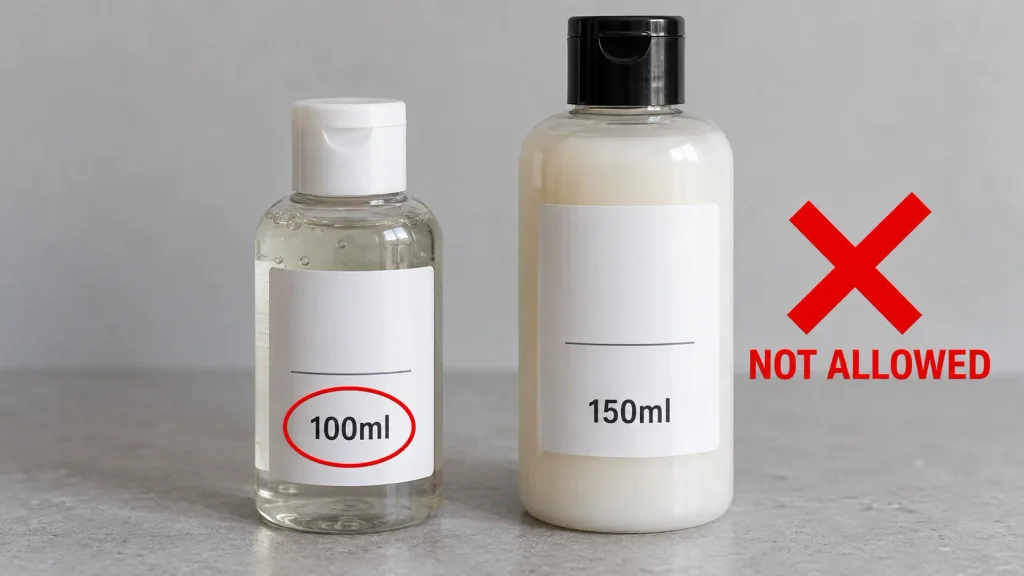
Look for the millilitre marking printed or embossed on the container, usually near the bottom or on the back label. If it reads 100ml or less, it meets the container-size rule, subject to screening. If it’s higher, decant into travel-sized containers marked 100ml or less, or move the larger container to hold luggage.
One detail worth knowing before you buy a travel set: Manchester Airport’s own guidance says any container you bring yourself must have its measurement printed on it. Handwritten markings and stickers don’t count, and unmarked travel sets won’t get through.
Get the container sizes right and the rest of your liquids packing falls into place, starting with what’s changed about plastic bags and unpacking.
Plastic Bags and Removing Liquids: What Has Changed
The bag rules changed even though the container limit didn’t. That distinction is where most of the confusion lives.
No Clear Plastic Bag Required
Manchester no longer requires a separate clear plastic bag for liquids. Pack them in your hand luggage instead, so your toiletries stay with the rest of your belongings.
EXPERT TIP
At Manchester, liquids can stay in your hand luggage without a clear plastic bag, provided each container is 100ml or less.
The familiar reach for a clear bag still comes naturally at the security lane, but at Manchester I can leave my small toiletry bottles in my hand luggage. I keep them together so they’re easy to find if screening staff ask to see them. That avoids unpacking for a bag the airport no longer requires, while keeping the 100ml limit in mind.
Liquids Can Stay in Your Hand Luggage
You don’t need to take liquids out for screening. Each container must still be 100ml or less, and a half-full 150ml bottle still counts as over the limit.
Electronics: Laptops and Tablets Can Stay in Your Bag
Laptops, tablets and other electrical items can stay in your hand luggage during the search. Empty your pockets into your bag before screening, then follow any instructions from staff at the lane.
EXPERT TIP
Leave laptops and tablets in your bag at Manchester, but be ready to remove them if security staff ask.
The same bag may meet Manchester’s rules and face a different liquid limit at another airport, so the UK-wide comparison matters.
Manchester vs Other UK Airports: The 2026 Comparison
Manchester isn’t alone in keeping the 100ml rule. It hasn’t joined the 2-litre club either. On the Tuesday before October half-term, a colleague packed a half-empty bottle of sunscreen that held more than 100ml for a Manchester departure. She had spent the summer flying from Heathrow, where the 2-litre allowance is now standard, and assumed the relaxed rule had reached every UK airport.
Security at Manchester confiscated it before she reached the gate. The scanner rollout made everyone assume the cap had gone everywhere. It hasn’t, and that gap between airports is the detail the marketing never spells out. That split changes what you pack, not how you pack it. At all seven airports below, liquids can stay in your cabin bag and you no longer need a clear plastic bag.
The only question is the size of each container.
Airports That Allow Up to 2 Litres
Heathrow, Gatwick, Birmingham and Edinburgh now let each container hold up to 2 litres as of October 2026. The 100ml cap no longer applies at these four airports. A half-litre bottle of shampoo or a full-size sunscreen can go through in your hand luggage, as long as it fits your airline’s size and weight limits and passes screening. Metal or double-walled bottles must be empty at these four airports. Separate dangerous-goods restrictions still apply to aerosols and some other products.
Airports Still Enforcing 100ml
Manchester, Luton and Stansted still cap every container at 100ml, even though liquids can stay in your bag and no plastic bag is needed. This is the rule to check before you pack: a 150ml bottle that is only a quarter full will still be confiscated at Manchester, because the container itself is over the limit.
UK Airport Liquid Allowance Comparison Table
| Airport | Liquid container limit | Clear plastic bag required | Liquids removed from bag |
|---|---|---|---|
| Manchester | 100ml | No | No |
| Heathrow | 2 litres | No | No |
| Gatwick | 2 litres | No | No |
| Birmingham | 2 litres | No | No |
| Edinburgh | 2 litres | No | No |
| Luton | 100ml | No | No |
| Stansted | 100ml | No | No |
Last checked: 18 October 2026. Confirm your airport’s current status on its official security page before you fly.
The airport split is only half the story. Medicine and baby milk have their own rules that apply everywhere, and those come next.
Medicine, Baby Milk and Dietary Liquid Exceptions
The 100ml rule has important exceptions, and knowing them can save a journey.
“Can I take my baby’s milk through?” is the question I hear most at the security queue, and it always reveals the same gap: passengers know the 100ml rule but not the under-36-months exemption.
Essential Liquid Medicine
Liquid medicine over 100ml is allowed when it’s for essential medical purposes and you carry a prescription or medical note. Pack only what you need for the journey. Security staff may need to open it for screening, so keep it where you can reach it quickly. Proof is not required for liquid medicine in containers of 100ml or less.
EXPERT TIP
For essential liquid medicine over 100ml, carry a prescription or medical note and keep it in your hand luggage, not the hold.
Baby Milk, Sterilised Water and Baby Food
Baby milk, sterilised water and baby food are exempt from the 100ml container limit when travelling with a baby under 36 months. You can take enough for the whole journey. Each container is screened separately, and staff may open it to check the contents.
Breast milk has its own rules. You can carry it even without the baby, in containers up to 2,000ml each. Frozen breast milk is not allowed.
EXPERT TIP
Baby milk, sterilised water and baby food can exceed 100ml for babies under 36 months, but pack them where you can reach them quickly for separate screening.
Dietary Requirements and Special Foods
Liquid foods for special dietary requirements can exceed 100ml. Check with the airport before travelling if you are unsure whether your item qualifies. Ordinary food and drinks without an exemption still follow the normal 100ml rule, so check whether your item is a genuine requirement before packing it.
These exemptions apply at Manchester as they do across UK airports, but the duty-free rules that follow are where connecting flights catch people out.
Duty-Free and Connecting Flight Rules
Duty-free follows different rules than landside packing, and connecting flights add a layer most travellers miss.
Buying Duty-Free After Security
Once you’re airside, liquids bought after security can come on board, subject to your airline’s rules. For duty-free liquids that must pass through security at Manchester, the items must be sealed in a transparent security bag at the point of purchase with the receipt sealed and visible inside. Manchester requires that receipt to show the purchase was made within 24 hours, and you must not open the bag until your final destination. Security staff may open it for screening. The same applies to duty-free bought at another airport: sealed bag, visible receipt, unopened.
On a Manchester connection through Dublin, I tore open the sealed duty-free bag to grab the perfume mid-layover. At Dublin security, the half-empty bottle went into the bin because the seal was broken. The fix was simple: buy after security, keep the bag intact, and check the connecting airport’s rules before spending. That mistake cost me a £40 bottle and a tense re-screening. Now I treat the sealed bag as part of my boarding pass: don’t touch it until I’m through my final destination’s arrivals hall. Dublin now permits containers up to 2 litres, including for passengers re-clearing security, so check its current rules rather than treating this past experience as today’s limit.
EXPERT TIP
Buy duty-free liquids after security, keep the sealed bag and visible receipt intact, and check whether any connecting airport will make you pass through security again before you buy.
Connecting Flights: The Hidden Risk
If a connection requires re-clearing security, that airport’s rules apply, not the departure airport’s. A 2-litre allowance at Heathrow, Gatwick, Birmingham or Edinburgh does not transfer to a connection at an airport still enforcing 100ml. A sealed duty-free security bag can qualify for an exemption even at a 100ml airport. Check the connecting airport’s acceptance and screening requirements before relying on it.
Now let’s turn all of this into a practical packing plan.
Packing Checklist and Hold Luggage Advice
Here’s the packing plan that turns Manchester’s 2026 rules into a stress-free trip through security.
What to Pack in Hand Luggage
Keep every non-exempt liquid, aerosol and gel in a container of 100ml or less, and leave it inside the cabin bag. Manchester’s CT scanners read the bag without unpacking, so the small tube of toothpaste, the 100ml sunscreen and the travel-size deodorant all stay put.
Essentials that must travel with you go in the same bag: essential liquid medicine with proof easy to reach if its container is over 100ml, baby food and milk needed for the flight, and your laptop or tablet left in the bag for screening.
Detailed exceptions for medicine and baby milk are covered in the dedicated section.
The tray’s rubber edge made a faint squeak as it slid toward the CT scanner, and the only thing I’d checked twice was the 100ml mark on my toothpaste. That was the setting that mattered. Every non-exempt liquid container in the cabin bag had to sit at or under 100ml, and because Manchester’s scanners let liquids stay in the bag, the packing pass became a label check, not an unpacking drill. I left the full-size shampoo in the hold bag and kept the small tube in the cabin bag. The whole thing took under a minute at the bench.
What to Move to Hold Luggage
Non-exempt liquids in containers over 100ml belong in hold luggage if you want to take them from home. Full-size shampoo, conditioner, shower gel, and large jars of peanut butter or jam can go in the checked bag, subject to airline and dangerous-goods restrictions. This removes the 100ml security container limit and keeps the cabin bag light. Exempt medicines, baby milk and qualifying sealed duty-free purchases follow the separate rules above; buying duty-free before a checkpoint does not automatically require putting it in the hold. Toiletry aerosols and medicinal/toiletry articles are limited to 0.5kg or 0.5 litres per item and 2kg or 2 litres combined per person; aerosol valves must be protected.
EXPERT TIP
Where you don’t need a non-exempt liquid during the flight, move it to hold luggage if permitted. This removes the 100ml security container limit; airline and dangerous-goods restrictions still apply.
Speed Through Security: Practical Tips
Use the printable checklist below before you pack. Keep non-exempt liquids in containers of 100ml or less in the bag, have medicine proof accessible, and check each airport separately if your journey includes more than one UK airport.
EXPERT TIP
If your journey includes another UK airport, check that airport’s own rules before you pack, because limits still differ between terminals.
Print or screenshot this checklist, then tick each box as you pack.
| Bag | Item | Done |
|---|---|---|
| Cabin bag | Non-exempt liquids, aerosols and gels each in containers of 100ml or less, left inside the bag | |
| Cabin bag | Essential liquid medicine, with proof of prescription easy to reach if its container exceeds 100ml | |
| Cabin bag | Baby food and milk needed for the journey; baby travelling where required, with the separate breast-milk exception | |
| Cabin bag | Laptop, tablet and other electronics left in the bag for CT screening | |
| Hold bag | Non-exempt liquids over 100ml, full-size toiletries and spreads in large jars, subject to airline and dangerous-goods limits | |
| Before leaving | Tick each item, then check the Manchester Airport security page before departure for any last-minute changes |
Rules are one thing. Here’s how they apply to your specific journey.
Scenario-Based Packing Guide
Different passengers face different packing decisions at Manchester Airport. Find your scenario below and jump straight to the advice that matches your journey.
Family Travelling with Baby Milk
Pack enough baby milk, sterilised water and baby food for the journey, and keep them easy to reach for screening.
There’s no legal limit on how much you can carry for the trip, but breast-milk containers must hold no more than 2,000ml each, and staff may open them to screen the contents. The screening handoff is quicker in the family scenario I plan for because I’d keep the milk accessible, ready for staff to screen and, if needed, open. Pack adult toiletries in containers no larger than 100ml or put them in hold luggage.
Traveller with Essential Medication
Keep essential medication in its original packaging, carry proof of prescription (a prescription, prescription label or doctor’s letter) for liquid medication in containers over 100ml, and pack only what you need for the journey. Tell security staff about it and be ready for separate screening, particularly if it’s over 100ml.
Hand-Luggage-Only Flyer
Decant toiletries into containers no larger than 100ml, then check the capacity printed on each one before leaving home. A half-empty 150ml bottle still gets confiscated. Liquids and electronics can stay in your bag, as covered earlier.
Duty-Free Shopper
Buy duty-free Airside, after security. Keep the purchase in its sealed transparent bag with the receipt visible, showing it was bought within the last 24 hours. Check connecting-airport rules before relying on it, because a second security check can change what you’re allowed to keep. Do not open the bag yourself; it can qualify for a duty-free exemption if the receiving airport accepts it and it clears screening.
One last thing before you fly: the 48-hour recheck reminder and a quick reference summary.
Final Pre-Flight Checklist and Summary
One last pass through the bag before you zip it shut.
The 48-Hour Rule
Forty-eight hours out, I set the recheck reminder on my phone. This is my planning reminder, not an official airport deadline. The pattern repeats at Manchester every season: a passenger arrives with a 150ml bottle, convinced the new CT scanners mean any size works. The container goes in the bin, and they’re down the cost of it before they’ve reached the gate. The recheck takes two minutes. Skipping it costs the price of the confiscated bottle and the queue-side panic when the 100ml rule still bites. I check the night before and again on the train in, and it has saved me from that bin-side moment more than once.
The rules sit under active review, and the position differs airport by airport. The 2-litre allowance is live at Heathrow, Edinburgh and Birmingham, but Manchester still enforces the 100ml rule per container. A quick check within 48 hours of departure tells you which side of that line you’re flying through, because the answer isn’t the same everywhere.
Quick Reference Summary
Save or screenshot this list before you travel:
- Non-exempt liquid containers must be 100ml or less.
- No plastic bag required.
- Liquids stay in your hand luggage.
- Manchester still enforces the 100ml rule; some other major UK airports allow 2 litres.
- Check the official Manchester Airport security page within 48 hours of departure.
PRODUCT RECOMMENDATION
For the most current rules, use the official Manchester Airport security page and the UK Government’s liquid rules guidance; Use each airport’s own security page to compare airports before multi-airport trips.
Frequently Asked Questions
Does Manchester Airport still have the 100ml liquid rule in 2026?
Yes. Manchester still enforces 100ml per container. The 2-litre allowance has not been approved there, even though CT scanners are in use.
Do I need a clear plastic bag for liquids at Manchester?
No. Manchester no longer requires a separate clear plastic bag. Liquids can stay in your hand luggage, provided each container is 100ml or less.
Can I take a half-empty 150ml bottle through Manchester security?
No. Security checks the printed capacity on the container, not how much liquid is left. A 150ml bottle with 20ml left is still over the limit and will be confiscated.
Are baby milk and liquid medicine exempt from the 100ml rule at Manchester?
Yes, with conditions. Essential liquid medicine over 100ml is allowed with a prescription or medical note. Baby milk, sterilised water and baby food are exempt when travelling with a baby under 36 months. Breast milk can be carried in containers up to 2,000ml each, but frozen breast milk is not allowed.
Which UK airports allow 2-litre liquid containers?
Heathrow, Gatwick, Birmingham and Edinburgh allow up to 2 litres per container as of October 2026. Manchester, Luton and Stansted still cap containers at 100ml.
What happens to duty-free liquids on a connecting flight from Manchester?
If a connection requires re-clearing security, that airport’s rules apply. A sealed duty-free security bag may qualify for an exemption at a 100ml airport; check the connecting airport’s acceptance and screening requirements.